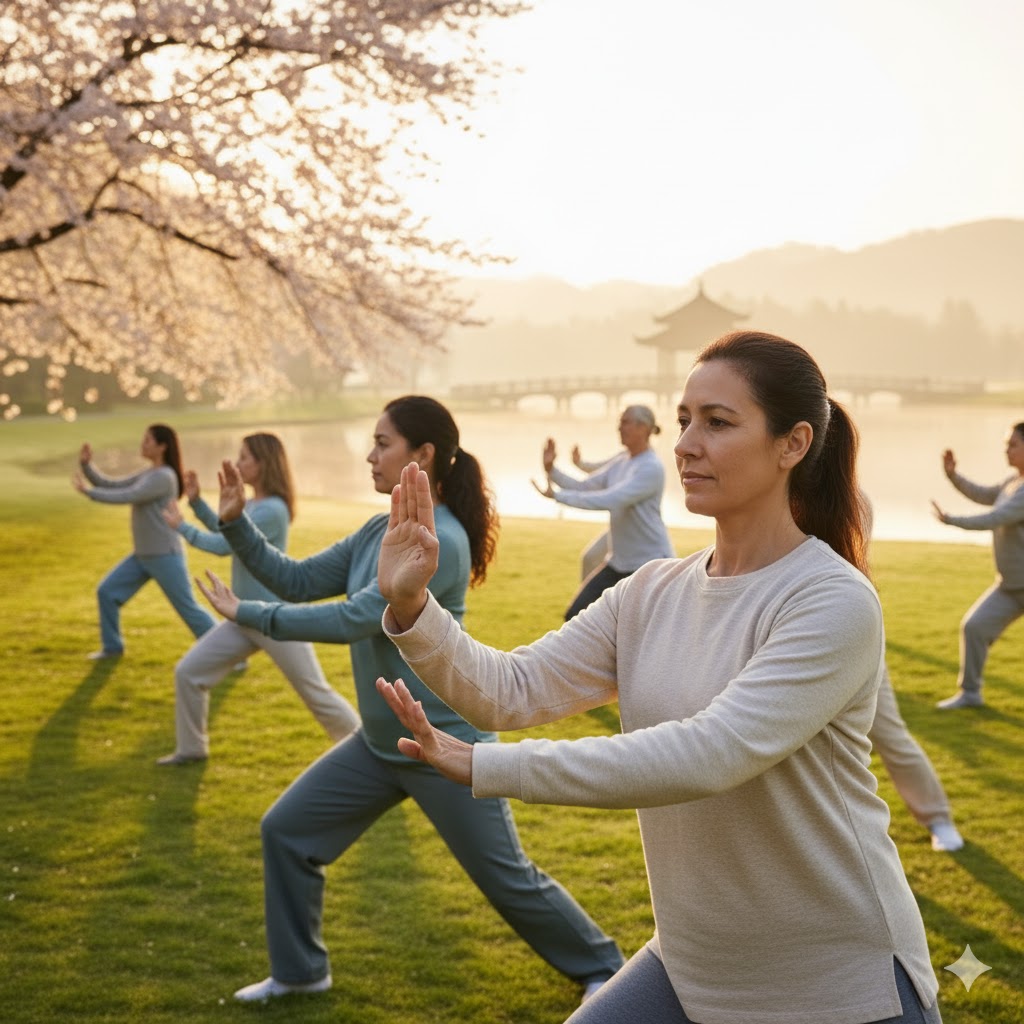
Awaken Your Inner Energy Flow Through Stillness and Breath
Introduction: The Art of Gentle Energy Cultivation
Qigong Meditation (氣功冥想)
Meaning:
- “Qi” (氣) = life energy or vital breath
- “Gong” (功) = skill, cultivation, or mastery
So Qigong means “the skill of working with life energy.”
Purpose:
Qigong meditation focuses on balancing, gathering, and circulating Qi within the body to promote healing, longevity, and spiritual awareness.
It combines slow, flowing movements, breathing techniques, and visualizations to open the body’s meridians (energy pathways).
Qigong meditation (pronounced chee-gong) is an ancient Chinese practice that harmonizes mind, body, and energy. Often described as “moving meditation,” Qigong blends slow rhythmic movement, conscious breathing, and mindful awareness to restore balance and vitality from within.
While yoga focuses on prana — the life force that flows through every living being — Qigong focuses on qi (or chi), the same vital energy that animates the body and the universe. Both systems share a common goal: to awaken a deeper connection between the physical and spiritual self.
The Roots of Qigong
The origins of Qigong reach back over 4,000 years to ancient China, where healers, monks, and martial artists developed it as a form of energy medicine and spiritual cultivation.
Early Daoist practitioners used Qigong to balance yin and yang — the natural opposites within the body. Over centuries, it evolved into multiple styles: medical Qigong for healing, martial Qigong for strength, and spiritual Qigong for enlightenment.
Today, Qigong is practiced worldwide and has been recognized by wellness experts and medical research institutions for its calming, restorative effects on the nervous system, mood, and overall vitality.
(Sources: Cleveland Clinic, Healthline, Taoist Sanctuary, YMAA Institute)
The Purpose of Qigong Meditation
At its heart, Qigong meditation teaches us to return to the natural flow of energy within.
It encourages:
- Relaxation of the body – releasing physical tension and blockages
- Calmness of the mind – softening mental noise through gentle focus
- Awareness of breath – connecting inner and outer rhythm
- Cultivation of qi – restoring life force to all organs and cells
Practicing Qigong is like recharging your internal battery — you learn to gather energy, circulate it, and store it for healing and resilience.
Benefits for Mind, Body & Spirit
Scientific and traditional teachings both highlight a wide range of benefits from Qigong meditation:
| Mind | Body | Spirit |
| Reduces anxiety and stress | Improves balance and posture | Deepens inner awareness |
| Enhances focus and clarity | Lowers blood pressure | Awakens energetic sensitivity |
| Supports emotional stability | Boosts immune function | Cultivates peace and gratitude |
| Improves sleep quality | Increases flexibility | Connects you with nature’s rhythm |
Modern research (National Library of Medicine, Brown University 2023) confirms that regular Qigong practice improves emotional regulation, fatigue, and quality of life.
Simple Beginner Practice: 5-Minute Qigong Meditation
Step 1: Ground Yourself
Stand with feet shoulder-width apart.
Keep your spine tall and knees slightly bent.
Relax your shoulders and jaw.
Step 2: Breathe Naturally
Close your eyes gently.
Take slow breaths — in through your nose, out through your mouth.
Feel your belly rise and fall with each breath.
Step 3: Gather Energy
Imagine a soft golden light above your head.
With each inhale, let it flow down through your body — head, shoulders, heart, belly, and legs — into the earth.
Step 4: Circulate and Calm
Now imagine this light returning upward with your exhale, completing a gentle loop through your body.
Smile softly and feel the warmth of inner balance.
Step 5: Close the Practice
Bring your hands together over your lower abdomen (the Dantian).
Take three slow breaths, silently thanking your body for its energy.
End with a gentle bow or smile.
Practice daily for 5–10 minutes to feel a noticeable calm in your body and clarity in your mind.
How Qigong Complements Yoga Practice
For the Yoga947 community, Qigong meditation beautifully complements yoga by:
- Offering gentle movement on days when physical asanas feel intense
- Enhancing energy awareness during breathwork and meditation
- Supporting emotional grounding through still standing or seated postures
- Providing a holistic balance between action (yang) and rest (yin)
Together, Yoga and Qigong create a complete cycle — one that nurtures vitality, peace, and presence.
Qigong Meditation – Frequently Asked Questions (FAQ)
By Yoga947
1. What is Qigong?
Qigong (pronounced “chee-gong”) is an ancient Chinese healing and movement practice that combines gentle physical postures, breathing techniques, and focused intention to cultivate Qi (life force energy). It’s designed to harmonize the body, mind, and spirit through mindful movement.
2. How does Qigong differ from Tai Chi?
Both Qigong and Tai Chi share similar roots in Chinese philosophy and energy medicine. Qigong focuses more on internal energy cultivation and can include standing, sitting, or moving meditations. Tai Chi, on the other hand, is a structured martial art form involving a set sequence of slow, graceful movements. Think of Qigong as the foundation from which Tai Chi evolved.
3. What are the main benefits of practicing Qigong?
Regular Qigong practice can help:
- Reduce stress and anxiety
- Boost immune function and circulation
- Improve flexibility, balance, and coordination
- Enhance focus and emotional stability
- Support spiritual awareness and inner peace
Many practitioners describe it as a gentle yet powerful self-healing art.
4. Is Qigong suitable for beginners?
Absolutely! Qigong is accessible to all ages and fitness levels. Movements can be modified or performed seated, making it ideal for beginners or those recovering from illness or fatigue. You don’t need any special equipment — just a calm space and comfortable clothing.
5. How often should I practice Qigong?
Even 5–10 minutes daily can bring noticeable calm and balance. Over time, consistent practice helps you tune into your body’s natural rhythms and improve your overall energy flow.
6. Can Qigong help with emotional healing?
Yes. Qigong encourages a mind-body connection that allows stored emotions to gently release through breath and movement. Many practitioners use Qigong to cultivate emotional resilience, forgiveness, and self-compassion.
7. Is Qigong a spiritual practice?
Qigong can be purely physical, meditative, or deeply spiritual — depending on your intention. Traditionally, it integrates Taoist and Buddhist philosophies, focusing on unity with nature, mindfulness, and the cultivation of inner stillness.
8. Do I need a teacher to learn Qigong?
While self-practice videos and online guides are helpful, learning from a qualified Qigong instructor — even for a few sessions — can ensure correct posture, breathing, and energy awareness. Yoga947 also offers guided meditation resources to help you begin safely at home.
9. How soon will I feel results from Qigong?
Some people notice an immediate sense of calm and clarity after one session. With regular practice, deeper benefits such as increased vitality, better sleep, and improved focus develop gradually over weeks or months.
10. How can I start a Qigong meditation routine with Yoga947?
Visit Yoga947.com to explore our guided Qigong Meditation steps, complete with beginner-friendly scripts, soothing audios, and printable wellness tools to support your energy journey.
Coming Soon!
Final Reflection: Flow Where Energy Meets Awareness
Qigong meditation reminds us that healing begins within.
Each mindful breath restores harmony between the body and the natural world — a reminder that stillness is strength, and movement is meditation.
Whether you stand beneath the sky or sit in silent breath, your qi flows through all that you are.
Start today — just five minutes of Qigong can awaken a lifetime of inner calm.
References & Suggested Reading
- Cleveland Clinic. What Are the Health Benefits of Qigong? (2023)
- Peter Deadman. A Brief History of Qigong (2021)
- Brown University Research. Qigong and Fatigue Reduction in Cancer Survivors (2023)
- YMAA Publications. The Root of Chinese Qigong by Dr. Yang, Jwing-Ming
- Taoist Sanctuary of San Diego. History of Qigong
National Center for Complementary and Integrative Health (NCCIH): Qigong Overview
 yoga947com.blog