How much of your well-being is of an importance to you?
Yoga is a timeless and transformative practice that has transcended centuries and cultures to become a global phenomenon. Rooted in ancient traditions and philosophy, yoga is far more than a physical exercise. It is a holistic system. Yoga unites the body, mind, and spirit. It has evolved into a diverse and dynamic array of practices. Each practice offers unique paths to self-discovery, well-being, and spiritual growth. Yoga ranges from the serene stillness of meditation to the dynamic and strength-building asanas (poses). It covers a wide spectrum of techniques and philosophies. These cater to individuals of all ages and backgrounds.
Yoga is more than just physical postures and exercises. It is a philosophy and a way of life. It is also a path to inner and outer harmony. It encourages self-awareness, mindfulness, and a deep connection with one’s inner self and the world at large. In today’s fast-paced and often stressful world, yoga offers a sanctuary. It helps those seeking balance, health, and a profound sense of purpose.
We will explore yoga’s rich history. We will look into its various branches and styles. We will also discuss the myriad physical, mental, and spiritual benefits it offers. Whether you are a seasoned practitioner or a newcomer to yoga, this journey into yoga is enlightening. It promises to be inspiring. Discover yoga’s timeless wisdom. See its contemporary relevance. Join us on a voyage of self-discovery, well-being, and spiritual fulfillment.
Our Website contains affiliate links this means if you click and make a purchase we may receive a small commission.“Don’t worry there is no extra cost to you. It’s a simple way you can support our mission to bring you quality content.
You’re not weak. You’re not broken. And you’re not “too sensitive.”
You may be overloaded.
Your nervous system is designed to protect you — constantly scanning for safety. It reads tone shifts, deadlines, notifications, conversations, facial expressions, and even your own thoughts.
But when stress becomes constant, your system doesn’t receive the signal that it’s safe to stand down.
Instead, it stays alert. Or it shuts down.
And often, you don’t realise it’s happening until your body starts whispering — or shouting.
In this guide, we’ll gently explore seven common signs of nervous system overload — and simple, grounded ways to reset without pushing yourself harder.
Because regulation isn’t about doing more. It’s about feeling safe enough to soften.
⚠️ Important Note
This article is for educational and wellness purposes only. It is not intended to diagnose, treat, or replace professional medical or psychological care. If you are experiencing severe or persistent symptoms, please consult a qualified healthcare professional.
What Does “Nervous System Overload” Actually Mean?
Your nervous system is constantly scanning for safety or threat. This subconscious process is called neuroception, a term introduced by Dr. Stephen Porges in his development of Polyvagal Theory.
When stress becomes chronic, the body can become stuck in:
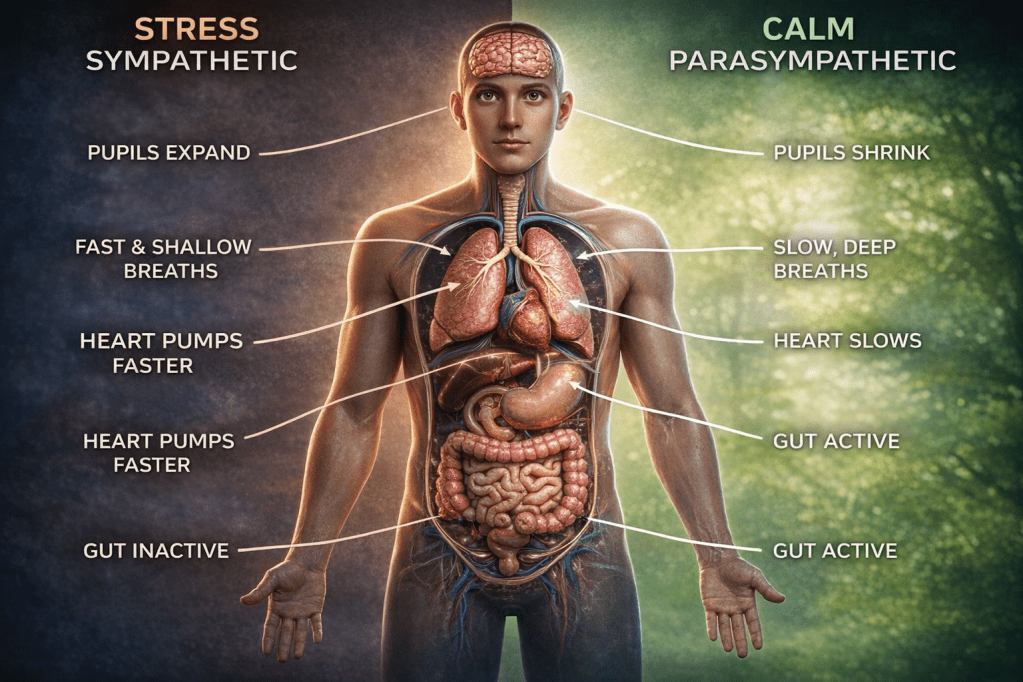
Digestive stress can ripple throughout the body when the nervous system remains in survival mode.
Gentle Reset for Gut Tension
• Practice belly breathing (hands on lower ribs) • Eat slowly without screens • Choose warm, nourishing meals • Take a 5-minute post-meal walk
Educational Disclaimer (Place Under Diagram)
This visual guide illustrates common stress-related patterns for educational awareness only. It is not intended to diagnose medical conditions. Please consult a healthcare professional for medical concerns.
4. You Struggle to Focus
You start tasks but cannot finish them. Your mind feels scattered.
Why
The brain prioritises survival over concentration.
Gentle Reset
• Take a 90-second pause • Stand up and shake out tension • Focus on one task for 10 minutes
5. You Feel Emotionally Numb
Not anxious. Not calm. Just flat.
Why
Your nervous system may have shifted into freeze mode to conserve energy.
Gentle Reset
• Gentle movement (walk or stretch) • Hold a warm mug of tea • Play soft instrumental music
6. You’re Easily Irritated
You react before you can think. Your fuse feels shorter than usual.
Why
Your system is primed for threat detection.
Gentle Reset
• Pause before responding • Step outside briefly • Make your exhale twice as long as your inhale
7. You Avoid People or Social Interaction
Withdrawal can be protection.
When overloaded, social engagement may feel draining.
Gentle Reset
• Text one safe person • Sit near others without pressure to speak • Step outside into nature for 5 minutes
• Stress level • Energy level • Emotional tone • Regulation tools used
This simple daily awareness tool helps you notice patterns without criticism.
When to Seek Professional Support
If symptoms are persistent, severe, or interfere with daily functioning, consider seeking support from:
• Your GP (UK primary care provider) • A licensed therapist • A trauma-informed practitioner
Seeking support is a sign of strength, not failure.
Closing Reflection
Your nervous system isn’t asking you to become someone new.
It’s asking for rhythm. For pauses. For safety. For breath.
Overload doesn’t mean failure — it means your system has been carrying more than it was designed to hold without rest.
Small daily resets create powerful change over time.
If this article resonated with you, begin with awareness. Even a simple daily check-in can shift everything.
Download the free Yoga947 Nervous System Check-In Tracker below and begin noticing your patterns with kindness.
Regulation begins with recognition.
And you are already beginning.
“Peace begins within — one breath, one vibration at a time.”
— Yoga947
Frequently Asked Questions
Nervous System Overload & Gentle Reset Support
1. What does it mean when your nervous system is overloaded?
When your nervous system becomes overloaded, it means your body has been exposed to too much stress or stimulation for too long without enough recovery time.
Your nervous system may stay in a constant state of alert (fight-or-flight) or shutdown (freeze), making it harder to relax, think clearly, or feel emotionally balanced.
The good news is that the nervous system is highly adaptable and can learn to return to balance with supportive practices.
2. What are the most common signs of nervous system overload?
Common signs include:
Feeling constantly tired or wired
Difficulty concentrating
Irritability or emotional sensitivity
Digestive discomfort
Sleep disturbances
Feeling overwhelmed by small tasks
Muscle tension or headaches
These signs are often your body’s way of asking for gentler pacing and support.
3. Can nervous system overload go away on its own?
Sometimes symptoms ease when stress levels reduce, but intentional regulation practices can speed up recovery.
Simple practices such as:
breathing exercises
grounding techniques
journaling
gentle movement
mindful pauses
can help signal to your body that it is safe to soften again.
4. How long does it take to regulate the nervous system?
Every person is different. Some people notice improvements within a few days of consistent calming practices, while others may take weeks or longer depending on lifestyle, stress levels, and support systems.
The key is small, consistent habits rather than forcing quick results.
5. Can meditation really help calm the nervous system?
Yes. Many meditation and mindfulness practices are designed to activate the parasympathetic nervous system, which supports rest, digestion, healing, and emotional regulation.
Practices such as:
breath awareness
humming meditation
grounding meditation
gentle visualisation
can help the body move out of survival mode.
6. Why do small things suddenly feel overwhelming?
When the nervous system is overloaded, your stress tolerance window becomes smaller.
This means that tasks that once felt manageable—emails, decisions, conversations—can suddenly feel exhausting.
This isn’t a personal failure. It’s often a biological signal that your system needs recovery time.
7. Can sleep problems be linked to nervous system overload?
Yes. When the nervous system is stuck in a state of alertness, the body may struggle to fully relax at night.
Common sleep challenges include:
difficulty falling asleep
waking during the night
restless sleep
waking up feeling tired
Gentle calming rituals before bed can help signal safety to the body.
8. What is the fastest way to calm the nervous system in the moment?
A few simple techniques can help within minutes:
slow breathing (longer exhales)
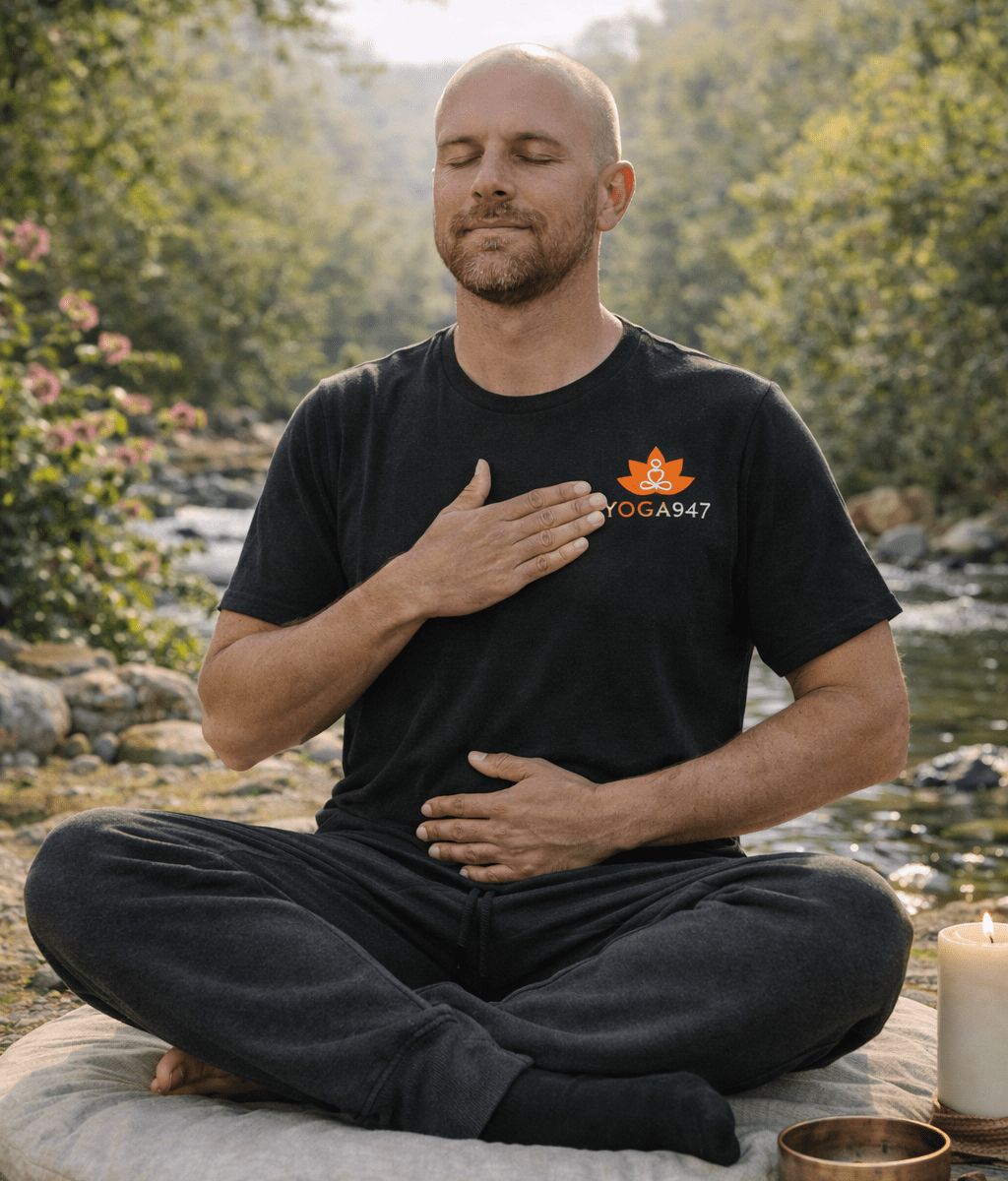
placing your hand on your chest or stomach
stepping outside for fresh air
gentle humming or vibration exercises
focusing on physical sensations like your feet on the ground
These practices help bring the body back into the present moment.
9. Is nervous system overload the same as burnout?
They are closely related but slightly different.
Burnout often develops after long periods of emotional or work stress. Nervous system overload refers more broadly to the body’s physiological response to ongoing stress or stimulation.
Many people experiencing burnout are also experiencing nervous system dysregulation.
10. When should someone seek professional support?
If symptoms feel persistent, overwhelming, or begin to impact daily functioning, it can be helpful to seek guidance from a qualified healthcare professional, therapist, or nervous-system-informed practitioner.
This article is designed for educational and wellness support only and is not a substitute for professional care.
A Gentle Next Step (Coming Soon)
Many readers have asked for simple ways to begin supporting their nervous system after recognising the signs of overload.
To help with this, Yoga947 is preparing a small companion guide designed to support your daily regulation practice.
The upcoming guide will include:
• A simple nervous system awareness tracker • A gentle 7-day reset reflection page • A short calming practice you can use anytime • supportive affirmations for emotional balance
This resource is designed to be simple, supportive, and easy to use during stressful moments.
✨ The Yoga947 Nervous System Reset Companion will be available soon.
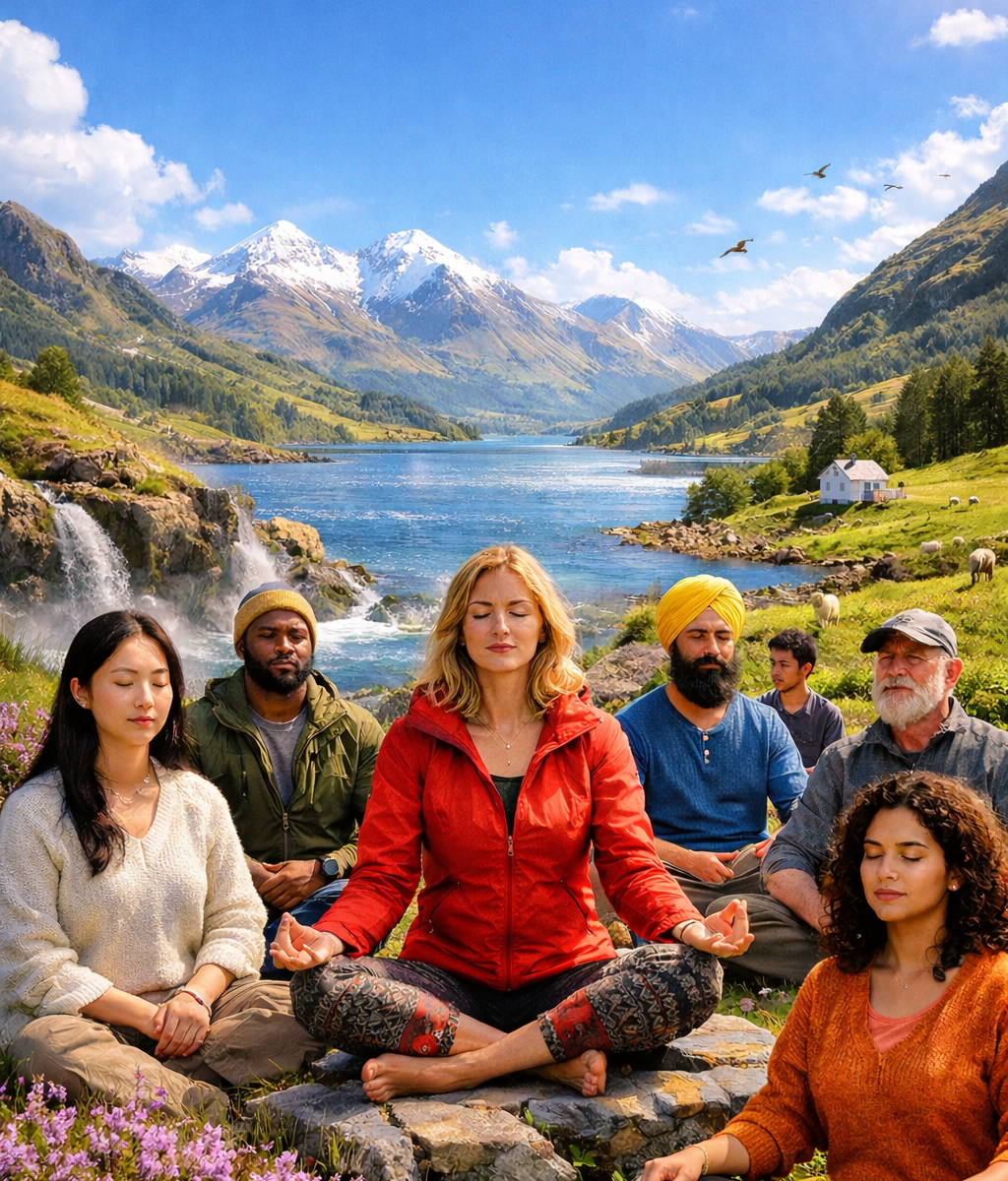
When people imagine meditation, they often picture stillness, silence, and long periods of inward focus. While this traditional approach works well for some, it can feel inaccessible—or even uncomfortable—for those with ADHD. Fortunately, meditation does not have to mean sitting perfectly still with a quiet mind. In fact, one of the most effective forms of meditation for ADHD is grounding, sensory-rich practice. Few places in the world support this style of meditation as effortlessly and beautifully as Scotland.
The Power of Sensory-Grounded Meditation
ADHD brains are often wired for stimulation, novelty, and movement. Rather than fighting this natural tendency, grounding meditation works with it. Sensory-rich meditation anchors awareness in the body and environment—engaging the senses of sight, sound, touch, and even smell. This approach reduces cognitive overload by giving the mind something tangible to focus on, creating calm through presence rather than forced stillness.
Scotland’s landscapes are inherently grounding. The environment invites awareness without demanding it, offering a natural rhythm that makes meditation feel intuitive rather than effortful.
A Landscape That Supports Presence
From mist-covered Highlands to rugged coastlines and ancient forests, Scotland provides an abundance of sensory input that is soothing rather than overwhelming. The rolling terrain naturally slows movement and breath. Wide-open spaces encourage expansive thinking while simultaneously grounding the body through scale and perspective.
For those with ADHD, this balance is crucial. Scotland’s landscapes are rich, but not chaotic. The muted greens, greys, and blues typical of the Scottish environment are calming, offering visual interest without excessive stimulation.
Soundscapes That Calm Rather Than Distract
Sound is one of the most powerful tools in sensory grounding, and Scotland excels here. The rhythmic crash of waves along the coastline, wind moving through tall grass, rainfall on stone paths, distant calls of seabirds, or the steady flow of a river all create natural soundscapes that support meditative awareness.
Unlike silence—which can sometimes amplify internal noise—the layered sounds of nature provide gentle, external focus. This makes it easier for ADHD minds to remain present without drifting into overthinking.
Connection Through Movement
Meditation in Scotland often happens through movement rather than stillness. Walking meditations along lochs, mindful hikes through glens, or slow exploration of forest paths allow the body to participate fully in the meditative process.
This embodied approach is particularly beneficial for ADHD individuals who may struggle with traditional seated meditation. Walking across uneven terrain, feeling the ground beneath each step, noticing shifts in temperature and light—all naturally draw attention into the here and now.
Weather as a Teacher of Awareness
Scotland’s weather is famously dynamic, and this variability is a gift for mindfulness practice. Shifting clouds, changing light, sudden rain, and fresh wind invite constant sensory check-ins. Rather than resisting discomfort, practitioners learn to notice sensations without judgment—feeling cool air on the skin, damp earth underfoot, or warmth when the sun briefly appears.
This ongoing sensory engagement helps ADHD minds stay anchored in present-moment awareness while building emotional regulation and resilience.
Ancient Energy and Psychological Safety
Many people report a unique sense of grounding in Scotland that goes beyond sensory input. The land carries a deep sense of history—ancient stone circles, ruins, castles, and sacred sites are woven into the landscape. For grounding meditation, this can foster a feeling of psychological safety and continuity, helping individuals feel supported and held by something larger than themselves.
For ADHD minds, which can be prone to racing thoughts or emotional intensity, this sense of rootedness can be profoundly calming.
A Place Where Meditation Feels Natural
Perhaps the greatest gift Scotland offers is permission. Permission to meditate without rigid rules. Permission to move, to observe, to feel, and to engage fully with the environment. Meditation here does not feel like an obligation or performance; it feels like a natural response to the land.
Whether standing quietly beside a loch, breathing in salt air on a coastal path, or walking mindfully through rain-soaked hills, Scotland invites a form of meditation that is alive, sensory, and accessible.
1. Why is sensory-rich meditation often easier for people with ADHD?
ADHD minds tend to seek stimulation and novelty. Sensory-rich meditation works with this natural wiring by anchoring attention in sound, movement, texture, and environment rather than forcing sustained internal focus or silence.
2. Is this still considered “real” meditation?
Yes. Meditation is defined by present-moment awareness, not by posture or stillness. Walking, observing nature, and engaging the senses mindfully are all recognised forms of meditative practice.
3. Do I need to be in Scotland for this type of meditation to work?
Scotland offers an ideal environment, but the principles of sensory-rich meditation can be practised anywhere. The key elements are movement, sensory awareness, and environmental engagement—not a specific location.
4. How long should sensory-based meditation sessions last?
Short sessions are often most effective. Even 5–15 minutes of mindful walking or sensory awareness can provide regulation and calm, especially for ADHD minds.
5. What if I struggle with traditional seated or silent meditation?
That’s very common. Sensory-rich meditation is a supportive alternative that removes pressure to sit still or quiet the mind, making meditation feel accessible rather than frustrating.
6. Can sensory-rich meditation help with emotional regulation?
Yes. By grounding attention in physical sensation and environment, this approach supports nervous system regulation and can reduce overwhelm, restlessness, and emotional intensity over time.
7. Is movement-based meditation suitable for beginners?
Absolutely. Many beginners find this style more intuitive because it mirrors how attention naturally moves and responds to sensory input.
8. Can this type of meditation be practised indoors?
Yes. While nature is especially supportive, sensory-rich meditation can be adapted indoors using gentle sound, mindful movement, breath awareness, and tactile grounding.
9. Is sensory-rich meditation suitable for neurodivergent adults and children?
This approach is often particularly supportive for neurodivergent individuals because it respects individual sensory needs and attention patterns rather than enforcing rigid techniques.
10. How often should I practise sensory-rich meditation?
Consistency matters more than duration. Regular short practices—several times a week or even daily—can be more beneficial than occasional long sessions.
11. Do I need special equipment or tools?
No. Sensory-rich meditation begins with awareness, not equipment. Some people later choose simple supports for comfort or focus, but these are optional rather than required.
12. What mindset is most helpful when practising this type of meditation?
Gentleness and curiosity. The goal is not to control attention but to notice sensations as they arise, allowing the practice to feel supportive rather than effortful.
Final Thoughts
For those with ADHD, meditation works best when it meets the mind where it is rather than asking it to change. Scotland, with its rich sensory landscapes and grounding presence, offers an ideal environment for this approach. It transforms meditation from something to “do” into something to experience—fully, openly, and without strain.
In Scotland, mindfulness is not confined to a cushion. It lives in the land itself.
This page exists to support comfort and regulation for those who find practical structure helpful.Yoga947 Resources Free tools and gentle companions to support mindful living
🟢
At Yoga947, meditation is not about perfection or pressure. It is about meeting yourself where you are — with awareness, gentleness, and practical support.
This page gathers free Yoga947 resources designed to support grounding, calm, and nervous system regulation. Each tool is optional and can be used in your own way, at your own pace.
🟢 Sensory & ADHD-Friendly Meditation
Sensory-Rich Meditation Checklist
A gentle companion for grounding, movement, and calm — especially supportive for ADHD minds.
This free checklist supports sensory-based meditation through movement, sound awareness, and environmental grounding. Designed to reduce overwhelm and encourage presence without rigid rules.
A Gentle Practice for Emotional Healing, Nervous System Calm, and Inner Safety
Grief is not something to “get over.” It’s something we learn to carry with tenderness, one moment at a time.
When you’re grieving, your nervous system may swing between heaviness, numbness, anxiety, tearfulness, or emotional shutdown. Grief & Softening Meditation is a gentle, body-aware mindfulness practice that helps you soften around pain instead of tightening against it—so emotions can move through with less overwhelm.
This practice may support you through:
Loss of a loved one (recent or long ago)
Relationship endings or estrangement
Changes in identity, health, home, or work
“Hidden grief” (unprocessed sadness you can’t explain)
Emotional fatigue, burnout, or a heavy heart
This is not about forcing release. It’s about creating enough safety inside your body that grief can be held with compassion.
What Is Grief & Softening Meditation?
Grief & Softening Meditation blends:
Mindfulness (noticing what is present without judgment)
Somatic awareness (listening to the body’s signals)
Compassionate inner language (gentle phrases that reduce self-criticism)
Slow breathe + softening (signaling safety to the nervous system)
Instead of “thinking through” grief, you practice being with it—carefully, kindly, and at your own pace.
Why “Softening” Helps When You’re Grieving
Grief often shows up as tension:
Tight chest or throat
Shallow breathing
Heavy belly
Clenched jaw, shoulders, or hands
Foggy thinking, agitation, or emotional numbness
Softening doesn’t mean your grief disappears. It means you stop fighting your own experience—and that alone can reduce suffering.
What Research Suggests About This Kind of Meditation
Research on mindfulness- and compassion-based approaches suggests they can help bereaved individuals in several ways:
Mindfulness-based interventions (MBIs) show promise for improving grief-related mental health outcomes (such as stress, depression, anxiety), while results can be mixed for prolonged grief symptoms specifically.
A large randomised clinical trial comparing grief-focused CBT vs mindfulness-based cognitive therapy (MBCT) found grief-focused CBT produced greater reductions in prolonged grief symptoms, but MBCT still produced meaningful improvements (including anxiety and quality of life gains).
Reviews and empirical work on MBCT in bereavement suggest mindfulness skills can help reduce rumination/overwhelm and improve daily functioning after loss.
Newer studies also explore self-compassion approaches for bereavement-related grief (including online group formats), supporting the idea that gentle, self-kind practices can be valuable alongside other supports.
Mindfulness and relaxation-based interventions have been studied for secondary grief outcomes (like depressive symptoms and affect), suggesting emotional regulation benefits may be one of the most reliable outcomes.
Yoga947 note (important): If you believe you may be experiencing Prolonged Grief Disorder or feel unable to function day-to-day, mindfulness can be a helpful support—but evidence suggests grief-focused therapy is often the most direct treatment for persistent, debilitating grief symptoms.
If it feels comforting, you may wish to include a candle during this meditation.
Soft light can help the body relax and give the mind a place to rest — especially when emotions feel tender. Some readers find calming scents like jasmine, lavender, or chamomile quietly supportive during moments of reflection.
Set up (30 seconds) Sit or lie down. Choose comfort over posture. Soften your gaze or close your eyes.
Take one slow inhale through the nose… and exhale gently through the mouth.
1) Arrive in the body (1 minute)
Notice where your body touches the chair or bed. Feel the support beneath you.
Quietly say: “In this moment, I am supported.”
2) Locate the grief gently (2 minutes)
Bring awareness to your chest, throat, belly, or face. Notice any tightness, heaviness, or numbness.
You are not trying to change it. You are simply acknowledging it.
Quietly say: “This is what I’m carrying today.”
3) The softening breath (3 minutes)
Inhale naturally. On the exhale, imagine the tight area softening 5%.
Not fixing—softening. Like unclenching a fist that’s been holding too long.
Repeat slowly: “Softening… just a little.”
4) Compassionate presence (3 minutes)
If emotion rises, allow it space. If tears come, let them. If numbness comes, let that be okay too.
Place a hand over your heart or belly if it feels supportive.
Say gently: “I can be with this.” “I don’t have to do this perfectly.” “I am allowed to grieve in my own way.”
5) Closing + return (1 minute)
Take one deeper inhale… and a long exhale.
Notice one small neutral detail around you (a sound, a temperature, the weight of your hands).
When you’re ready, open your eyes.
Closing line: “May I meet the next moment with gentleness.”
Grief often asks for simplicity. A single candle, a quiet breath, and a few minutes of stillness can be enough.
Lighting a candle before your practice can become a small ritual — a signal to slow down and soften without needing to “fix” anything.
🌙 If you’re looking for candles that many people use for evening reflection or meditation, you can find a few gentle options here: 👉 [Browse reflection-friendly candles]
When to Practice
This practice is ideal:
Before sleep or after waking
After emotionally intense days
Around anniversaries or reminders of loss
When grief “spikes” suddenly
Anytime you feel braced, heavy, or shut down
Even 3–5 minutes helps.
Journaling Prompts for Grief Integration
After your meditation, try 1–3 prompts:
Where did I feel grief in my body today?
What would softening look like—just 5%?
What do I need most right now: rest, reassurance, connection, or space?
What am I afraid I’ll feel if I slow down?
What is one gentle thing I can do for myself today?
10 Frequently Asked Questions
1) Is this meditation suitable for fresh grief? Yes—because it is gentle and doesn’t force emotional processing. Go slowly and stop if you feel overwhelmed.
2) What if I feel numb instead of sad? Numbness is a valid grief response. Softening helps you stay present without forcing feeling.
3) Will this help with anxiety and stress from grief? Research suggests mindfulness approaches can reduce stress, anxiety, and depressive symptoms that can accompany bereavement.
4) What if I start crying? That can be a healthy release. Let tears come and keep your breath slow and gentle.
5) How often should I practice? Try 5–10 minutes daily for 2 weeks, or use it “as needed” when grief spikes.
6) Can this replace therapy or professional grief support? It’s supportive but not a replacement. If grief feels debilitating or persistent, grief-focused care can be especially helpful.
7) What if my grief becomes more intense during meditation? Pause. Open your eyes. Feel your feet. Name five things you can see. Return when you feel steadier.
8) Is “softening” the same as letting go? No. Softening is allowing your body to unclench around grief. You’re not asked to release love, memories, or meaning.
9) Does mindfulness help prolonged grief? Evidence suggests mindfulness may improve related symptoms (stress, mood), while results are mixed for prolonged grief itself; grief-focused approaches can be more targeted for PGD.
10) Can I do this at work or in public? Yes. A “micro-version” is: one slow exhale + soften shoulders + hand to heart for 10 seconds.
Summary
A Gentle Path Forward
Grief changes us—but it doesn’t have to harden us.
Grief & Softening Meditation is a way of saying: “I don’t need to fight my pain to survive it.” You can meet grief with breath, softness, and compassion—one moment at a time.
There is no right way to grieve — and no tools are required.
If candles feel supportive for you, I’ve shared a small collection that aligns with this practice. If not, your breath and presence are more than enough.
A Values‑Led Practice for Healthspan, Clarity & Sustainable Wellbeing
Introduction
As we move into 2026, the conversation around wellness is shifting. Longevity is no longer only about adding years to life — it is about healthspan: living longer with clarity, emotional balance, and energy that feels sustainable.
At the centre of this shift is purpose.
When daily habits are connected to what truly matters, they become easier to maintain. Purpose gives direction to choice‑making, supports resilience during stress, and helps prevent burnout from constant decision‑making.
This Purpose + Longevity Meditation is a gentle, practical practice designed to help you reconnect with your values, visualise a healthier future self, and anchor that insight into one small daily ritual you can realistically sustain.
What Is Purpose + Longevity Meditation?
Purpose + Longevity Meditation is a short, structured mindfulness practice that blends:
Values reflection — clarifying what truly matters right now
Guided visualisation — connecting with a future self living with greater vitality
One small daily ritual — a repeatable habit that supports long-term wellbeing
Rather than striving for perfection, this meditation helps you align meaning with consistency, which is where long-term change actually happens.
Where This Practice Comes From (A Brief History)
This meditation style is a modern synthesis, inspired by three well-established traditions:
1. Mindfulness Meditation
Rooted in ancient contemplative practices and widely studied today, mindfulness supports awareness, emotional regulation, and stress resilience.
2. Values-Based Reflection (Psychology)
Values clarification is central to modern therapeutic approaches such as Acceptance & Commitment Therapy (ACT). Reflecting on values helps people make choices aligned with what they care about most — especially during periods of change or uncertainty.
3. Visualisation & Guided Imagery
Visualisation has long been used in mind-body practices to support motivation, calm, and behaviour change. Imagining future outcomes can help bridge intention with action.
Together, these elements form a purpose-anchored meditation that feels both reflective and practical — ideal for longevity-focused living.
What Research Suggests (In Simple Terms)
While meditation is not a medical treatment, research consistently highlights supportive links between:
Purpose in life and improved health outcomes over time
Mindfulness practices and reduced stress, improved emotional well-being
Visualisation techniques and enhanced motivation, calm, and habit support
Small rituals and greater consistency, reduced anxiety, and meaning-making.
1) Purpose is associated with better health outcomes over time
Research literature links higher purpose in life with a range of favourable health outcomes in aging, and studies examine associations with mortality risk and other health markers.
Yoga947- friendly takeaway: Purpose doesn’t guarantee longevity—but it can be a powerful “health resource” that supports healthier choices and resilience.
2) Mindfulness supports psychological well-being and stress resilience
Mindfulness is consistently associated with psychological well-being and reduced stress, and intervention research continues to expand.
3) Visualization can support behaviour change + calm
Guided imagery / mental imagery interventions are used to support relaxation and can aid anxiety reduction and health behavior support in some contexts.
4) Small rituals help people stay consistent (and feel grounded)
Rituals can increase meaning and reduce anxiety by adding structure and intention—especially when life feels uncertain or busy.
The key takeaway:
Longevity is supported not only by what we do — but by why we do it.
The 9‑Minute Purpose + Longevity Meditation (Guided Script)
Minute 0:00–1:00 — Arrive
Sit comfortably. Gently inhale through the nose… exhale slowly. Allow your shoulders to soften.
Silently say: “I am here. I am listening.”
Minute 1:00–3:00 — Values Reflection
Ask yourself slowly:
What matters most to me right now?
What kind of person am I practising becoming?
Which value needs more care in this season of my life?
Choose one value.
Repeat internally: “My life is guided by ______.”
Minute 3:00–6:30 — Future Self Visualisation
Imagine yourself one year from now, living with steadier energy and clearer priorities.
Visualise an ordinary day. Notice how you wake up, how you move through your day, and how you speak to yourself.
Ask your future self: “What small daily practice made the biggest difference?”
Allow one answer to surface.
Minute 6:30–8:30 — One Small Daily Ritual
Choose one ritual that takes under two minutes.
Examples include:
Slow breathing before coffee
A glass of water and morning light
One sentence of journaling
Gentle posture or shoulder release
Clarify: When will I do it? Where will I do it?
Repeat: “I choose consistency over intensity.”
Minute 8:30–9:00 — Close
Hand to heart. One slow breath in… and out.
Affirm: “One day at a time. One choice at a time.”
Download the Free Purpose + Longevity Ritual Tracker
To support this meditation, Yoga947 has created a free 7‑Day Purpose + Longevity Ritual Tracker.
This printable and digital guide helps you:
Clarify your values
Choose one sustainable daily ritual
Track consistency without pressure
Reflect gently and recommit with kindness
👉 Download the Free Purpose + Longevity Ritual Tracker
Binaural meditation uses specially engineered audio tones — called binaural beats — played through headphones to gently influence brainwave patterns. This creates a perceived rhythmic tone in the brain that doesn’t exist in the recordings but is generated by the brain itself, based on the difference between two tones of slightly different frequencies played in each ear.
In a Binaural Focus Sprint Meditation, you guide listeners to use binaural beat audio specifically tuned to enhance focus, reduce stress, and cultivate mindful attention over a short, concentrated session — like a sprint for the mind.
Where It Began & How Long It’s Been Practised
Discovery (1839): German physicist Heinrich Wilhelm Dove first reported the binaural beat phenomenon, observing that when two different tones are delivered individually to each ear, the brain perceives a third “beat” frequency.
Modern Expansion (1970s): Biophysicist Dr. Gerald Oster brought binaural beats into scientific and popular contexts when he described and popularised the idea in a 1973 Scientific American article.
Today: While the concept is nearly two centuries old, its use as a meditation and focus aid has grown considerably in the last decade with digital audio platforms and meditation apps making binaural beat tracks widely accessible.
How It Works
Binaural beats aim to entrain brainwaves — meaning the brain may align its electrical activity to match the difference between the two audio frequencies you hear in each ear.
Lower frequencies like theta (4–8 Hz) are associated with relaxation and meditation.
Alpha waves (8–12 Hz) support calm focus.
Beta frequencies (13–30 Hz) align with alert, conscious attention.
The idea is that listening to the right binaural frequency may help your nervous system transition into a desired state — whether deep focus, relaxed awareness, or restful calm.
Benefits (What People Report & What Research Suggests)
While research is still emerging and not yet definitive, there is growing evidence and many anecdotal reports of benefits:
Focus & Attention
Some studies suggest binaural beats — especially in beta ranges — may help bias attention towards improved focus and reduced distractions.
Stress & Anxiety Reduction
Preliminary clinical research indicates binaural beats may reduce anxiety and lower physiological stress markers like blood pressure.
Relaxation & Mood
Using binaural beats at alpha/theta frequencies is commonly linked with a more relaxed mood and reduced stress.
Cognition & Memory
A few studies show potential improvements in memory, attention, and neural processing after repeated binaural beat sessions — though results are mixed and not universal.
Science Tip: Research on binaural beat entrainment finds some evidence of measurable brainwave effects, but scientists also note that outcomes vary widely between individuals, and larger controlled trials are needed for definitive claims.
What Research Guides Recommend
For those interested in exploring this scientifically:
Guidance
Listen for 10–20 minutes using good-quality stereo headphones (critical for true binaural beat perception).
Use tracks tuned to target specific brainwave bands depending on your intention (e.g., focus vs relaxation).
Combine this with traditional meditation cues (breath awareness, body scanning) for deeper practice.
Focus, One Moment at a Time
Binaural Focus Sprint Meditation offers a gentle yet structured way to reconnect with clarity in a world full of constant stimulation. By combining intentional awareness with carefully designed sound frequencies, this practice supports the mind in shifting toward a calmer, more focused state—without forcing concentration or effort.
While research into binaural beats continues to evolve, many people find this meditation especially helpful during periods of mental overload, decision fatigue, or creative stagnation. Practised consistently and mindfully, even short focus sprints can become powerful anchors throughout the day—helping you pause, reset, and return to tasks with renewed presence.
As with all meditation practices, the greatest benefit comes from personal experience rather than expectation. Approach binaural focus sessions with curiosity, patience, and self-compassion. Some days may feel deeply immersive; others may feel subtle—and both are valid.
At Yoga947, this practice is offered as a supportive tool—not a shortcut—to help you cultivate awareness, steadiness, and intentional focus. Let each session remind you that clarity is not something you chase, but something you gently return to—one breath, one sound, one moment at a time.
Frequently Asked Questions
Q: Do binaural beats really work? A: Some research suggests they may influence attention, stress, and mood, but scientific evidence is still emerging and effects vary by person.
Q: How long should I listen? A: Beginners often start with 10–20 minutes to feel noticeable effects without fatigue. Longer sessions are fine if comfortable.
Q: Do I need special equipment? A: Yes — binaural beat effects only occur if each ear hears a distinct frequency, so quality stereo headphones are essential.
Q: Can it replace meditation? A: Binaural beats can support meditation by helping shift brainwaves toward a relaxed or focused state, but they’re best experienced alongside mindful breathing or intentional awareness.
Products to Support Binaural Focus Sprint Meditation
High-Quality Headphones
• Good stereo separation is essential. • Wireless over-ear models often provide immersive comfort for meditation sessions.
Meditation cushion set, adjustable Eye mask, and Sound-comfort accessories.
“For optimal binaural beat meditation, we recommend using high-fidelity stereo — explore top rated options here: [Headphones].
Also consider a comfortable meditation cushion to support a relaxed posture.”*You can also link to your trusted site space — https://yogatrustedsite-space.trustedsite.space/ — as a resource hub where readers can find curated products and playlists that support their binaural focus sessions.
“Peace begins within — one breath, one vibration at a time.” — Yoga947
How to reset your mind, reduce overwhelm, and make better choices—one breath at a time.
If you’ve ever reached the end of the day and felt mentally “done,” unable to choose what to eat, what to reply, or what to do next—you’ve met decision fatigue. It’s the mental wear-and-tear that builds after repeated choices, problem-solving, self-control, and constant input.
Decision Fatigue Clarity Meditation is a simple mindfulness-based practice designed to quiet mental noise, restore attention, and help you return to clear, grounded decision-making—especially when you feel overstimulated or rushed.
What is decision fatigue (and why it affects clarity)?
Decision fatigue describes the decline in decision quality after long stretches of choosing, evaluating, resisting impulses, and managing tasks. In research, it’s often discussed alongside ego depletion and resource-based models of self-control—where repeated mental effort can temporarily reduce capacity or willingness to keep exerting control.
Common signs include:
Overthinking small choices
Procrastination or “decision avoidance”
Impulse decisions (grabbing the easiest option)
Irritability, brain fog, and reduced patience
Feeling overwhelmed by options (even good ones)
Where this meditation “began” (history & roots)
While the phrase decision fatigue is modern and widely discussed in psychology/health literature, the meditation approach for restoring clarity draws on older, well-established traditions:
1) Ancient roots: attention training for mental steadiness
Many contemplative traditions—especially Buddhist mindfulness practices—train the mind to notice distraction, return to the breath, and see thoughts clearly rather than being pushed around by them. This “returning” skill is the foundation of clarity when the mind is overloaded.
2) Modern roots: mindfulness-based programs
In the late 20th century, mindfulness entered mainstream health settings through structured programs (often called Mindfulness-Based Interventions). These modern approaches helped researchers test what meditation changes in attention, emotion regulation, and cognitive functioning.
So, Decision Fatigue Clarity Meditation is best understood as a modern application of mindfulness to a modern problem: too many decisions, too much input, too little recovery.
What research suggests (evidence-based view)
Meditation is not a magic switch—but research does support several mechanisms that matter directly for decision fatigue:
Improved attention & executive functioning
Studies show mindfulness/meditation training can support attention and aspects of executive functioning (skills like inhibition, working memory, and self-regulation), which are closely related to making better choices under stress.
Reduced fatigue, anxiety, and mental overload
Brief mindfulness training has been linked with improvements in fatigue and anxiety, alongside cognitive performance outcomes in some studies.
Better emotion processing (less reactivity)
When decision fatigue is high, emotional reactivity often rises. Brief mindfulness meditation has been associated with changes in emotion processing and reduced intensity of emotional responses in controlled research settings.
Important note (honest science): Researchers also debate how decision fatigue and ego depletion work, and effects can vary by context, stress, sleep, task type, and individual differences. A practical takeaway is still solid: recovery breaks that restore attention and reduce arousal help you choose better—and mindfulness is one tool that may do that.
The benefits of Decision Fatigue Clarity Meditation
With consistent use (even 3–7 minutes), many people report:
Silently say: “Clarity over chaos. One step at a time.”
Step 2: Exhale to signal “reset” (60 seconds)
Inhale through the nose for 4… Exhale slowly for 6… Repeat 5 times.
(Longer exhales help shift your nervous system toward calm, which supports clearer thinking.)
Step 3: Label the mental load (60–90 seconds)
Gently name what’s happening—no judgment:
“Too many tabs.”
“Too many decisions.”
“Pressure.”
“Overwhelm.”
Labeling reduces the “fight” with your thoughts and helps you observe rather than spiral.
Step 4: The clarity focus (3–5 minutes)
Bring attention to the breath at the nostrils or chest. When thoughts appear, use this simple cycle:
Notice → Name → Return
Notice: “Thinking.”
Name: “Planning / Worrying / Comparing.”
Return: back to breath.
You are training the brain’s return-to-focus muscle—the same muscle decision fatigue weakens.
Step 5: One-decision filter (60–90 seconds)
Ask yourself one question only:
“What is the next smallest decision I can make?” Not the whole plan. Not everything today. Just the next smallest step.
Examples:
“Drink water, then reply to one email.”
“Write the first paragraph.”
“Choose option A and move forward.”
Step 6: Close with a clarity cue (20 seconds)
Hand to chest (optional): “I choose calmly. I choose clearly.”
Feeling overloaded already? Get your FREE Decision Fatigue Clarity Reset PDF — including a calming 7-minute guided meditation, your One-Decision Filter, and affirmations you can use today.
Decision batching: choose meals/clothes/plans in one block (not all day long)
Defaults: set 2–3 go-to options (breakfast, workout, work start routine)
Reduce open loops: write 3 tasks on paper; ignore the rest for now
Protect sleep: decision fatigue is amplified by poor sleep and high stress (your brain needs recovery)
Frequently Asked Questions
Is this a new “type” of meditation? It’s best seen as a mindfulness-based clarity practice applied specifically to decision fatigue.
How fast does it work? Some people feel calmer immediately; deeper changes come with repetition. Even brief mindfulness sessions have shown measurable effects in controlled studies, though results vary.
What if I can’t stop thinking? You don’t need to stop thoughts. The practice is returning to the breath—again and again.
Should I use this before big decisions? Yes—especially if you’re emotionally activated, overwhelmed, hungry, or sleep-deprived. Use it to get back to baseline first.
A Final Reflection
Clarity is not something you force—it’s something you allow.
By creating space between thoughts and actions, Decision Fatigue Clarity Meditation helps you reconnect with calm awareness and intentional choice.
In today’s modern workplace, long hours at a desk, constant digital stimulation, and limited movement can take a serious toll on both mental and physical well-being. Chair-based office meditation offers a simple, accessible solution — allowing individuals to reset their nervous system, improve focus, and reduce stress without leaving their chair.
This form of meditation is increasingly recognised within workplace wellness programs for its ease of use, inclusivity, and research-backed benefits.
What Is Chair-Based Office Meditation?
Chair-based office meditation is a form of seated mindfulness practice designed specifically for workplace environments. It allows meditation to be practised while sitting in a chair, making it ideal for offices, remote workspaces, shared environments, and individuals with limited mobility.
Unlike traditional floor-based meditation, this approach focuses on:
Breath awareness
Body awareness while seated
Nervous system regulation
Gentle posture alignment
Mental clarity during the workday
The History of Chair-Based Meditation in the Workplace
Chair-based meditation evolved from traditional mindfulness practices, where posture has always been adaptable. In early Zen and Vipassana traditions, meditation could be practised seated on a chair when necessary.
During the late 20th century, meditation was adapted further through:
Chair-based office meditation offers a practical and accessible way to support calm, focus, and nervous system balance within the modern work environment. By integrating simple seated mindfulness practices into the workday, individuals can create moments of pause that help reduce stress, release physical tension, and restore mental clarity — without disrupting productivity or routine.
The FREE 7-minute chair-based meditation included above is designed to be used during natural workday transitions, breaks, or moments of mental fatigue. Practiced consistently, even for a few minutes at a time, this approach can support long-term emotional regulation, improved posture awareness, and a more grounded relationship with work demands.
Whether practiced daily or occasionally, chair-based meditation reminds us that calm does not require ideal conditions — only intention, awareness, and a willingness to pause.
You may return to this practice whenever the workday feels demanding, knowing that stillness and clarity are always accessible, even from your chair.
Want more support for workplace calm and focus? Join our mailing list for weekly practices, mini guides, and practical tips delivered straight to you.
Introduction: Why Fascia Release Matters in a Tense World
Modern life places constant strain on the body — prolonged sitting, repetitive movements, emotional stress, and shallow breathing all contribute to deep-seated tension. Often, this tension isn’t just in the muscles, but within the fascia, the connective tissue that links everything together.
Fascia Release Meditation is a gentle, mindful practice that combines breath, awareness, and subtle movement to soften restrictions in the fascia while calming the nervous system. Unlike forceful stretching, this approach works with the body — not against it — allowing release to happen naturally.
At Yoga947, fascia release meditation is taught as a body-mind reset, supporting mobility, emotional regulation, and long-term wellbeing.
What Is Fascia? (And Why It’s So Important)
Fascia is a continuous web of connective tissue that surrounds muscles, bones, organs, nerves, and blood vessels. It gives structure to the body while allowing fluid movement.
Key roles of fascia include:
Supporting posture and alignment
Transmitting force between muscles
Providing sensory feedback to the brain
Responding to stress, trauma, and emotional states
When fascia becomes dehydrated, overstimulated, or restricted, it can contribute to:
Chronic pain or stiffness
Reduced mobility
Fatigue and poor posture
Heightened stress responses
Meditation that focuses on breath and awareness helps restore hydration, elasticity, and communication within fascial tissue.
The History of Fascia-Focused Healing
Although fascia research is relatively modern, fascia-based practices have ancient roots.
Traditional Foundations
Yogic stretching, Qigong, and Tai Chi all emphasise slow, elastic movement that stimulates connective tissue.
Eastern body-mind systems recognised that tension and emotion live in the body, long before fascia was anatomically defined.
Modern Developments
Osteopathic medicine and physical therapy in the 20th century began studying fascia’s role in pain and mobility.
Myofascial release techniques emerged, focusing on sustained, gentle pressure rather than force.
Today, mindfulness and somatic practices integrate meditation with fascia awareness, bridging neuroscience, anatomy, and self-healing.
What Does Science Say? (Research-Based Evidence)
While “fascia release meditation” as a term is still emerging, research strongly supports its core components:
✔ Fascia & Sensory Awareness
Fascia contains a high concentration of sensory receptors, making it deeply responsive to slow movement and attention.
✔ Meditation & Pain Reduction
Studies show meditation can reduce chronic pain, anxiety, and sleep disturbances —all factors that influence fascial tension.
✔ Nervous System Regulation
Mindfulness practices reduce sympathetic (stress) activation, allowing fascia to soften rather than guard.
✔ Fascia-Focused Movement Studies
Clinical research demonstrates that regular fascial exercises improve:
Mobility and flexibility
Sleep quality
Anxiety and mood regulation
Headache and tension symptoms
Together, this supports fascia release meditation as a safe, evidence-aligned complementary practice.
Daily Benefits of Fascia Release Meditation
Practised consistently, this meditation supports:
1. Reduced Physical Tension
Gentle awareness helps release long-held restrictions without strain.
2. Improved Mobility & Flexibility
Fascia responds best to slow, mindful movement rather than forceful stretching.
3. Stress & Emotional Balance
Fascia tightens under stress — calming the nervous system allows it to unwind.
4. Enhanced Body Awareness
Develops proprioception and early awareness of tension patterns.
5. Better Sleep & Recovery
Relaxed fascia supports parasympathetic (rest-and-repair) states.
6. Injury Prevention
Improved tissue awareness encourages healthier movement habits.
How to Practice Fascia Release Meditation (Simple Daily Method)
Duration: 10–20 minutes Position: Seated or lying down
Begin with slow nasal breathing
Bring awareness to areas of tightness or heaviness
Visualise the tissue softening and expanding with each exhale
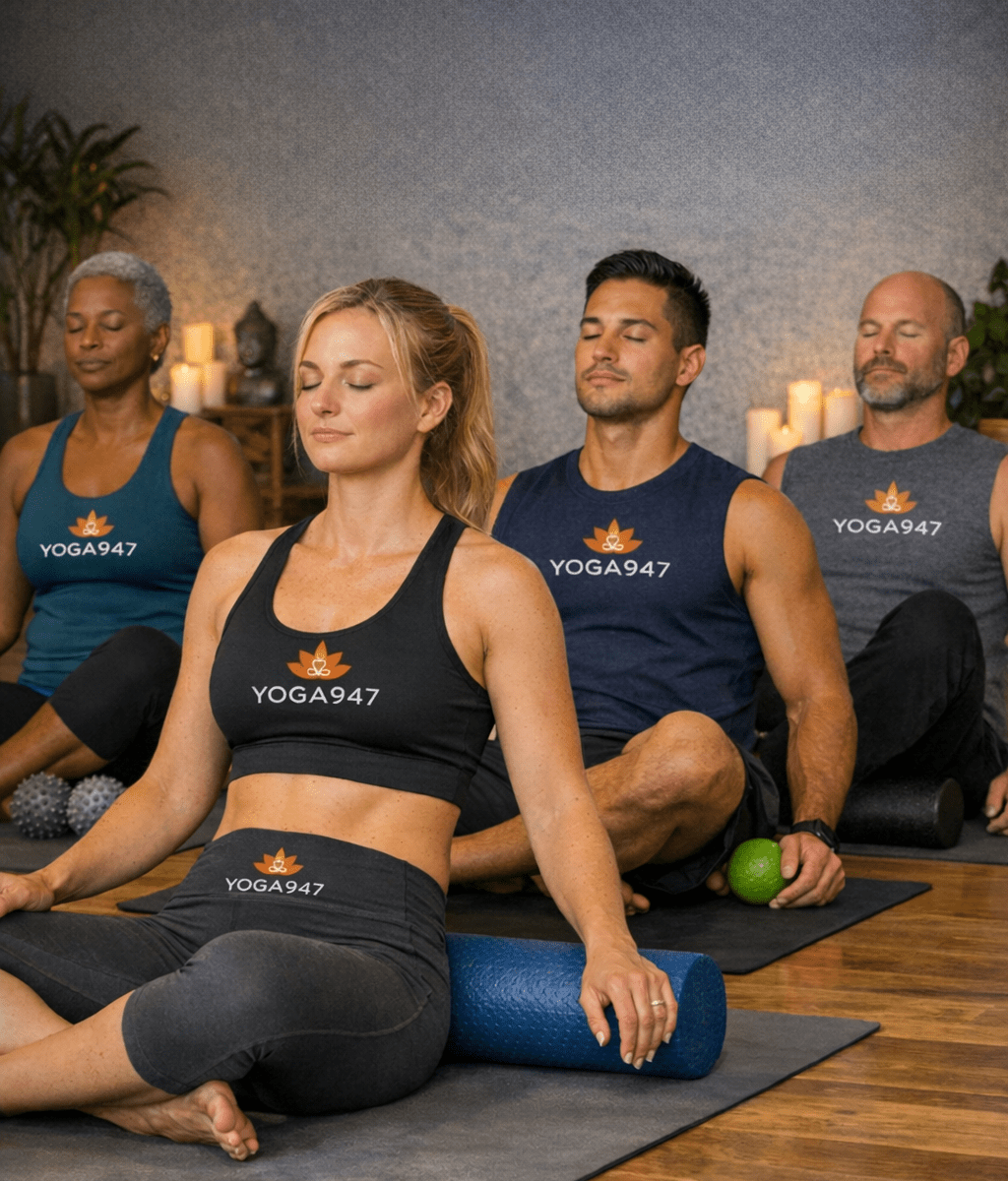
Foam rollers (gentle preparation before meditation)
Massage or fascia balls
Yoga blocks and straps
Meditation cushions and mats
Soft blankets for nervous system comfort
Frequently Asked Questions (FAQ)
Is fascia release meditation safe for beginners?
Yes — it is gentle, slow, and adaptable for all levels.
Is this the same as foam rolling?
No. Foam rolling is mechanical; fascia release meditation focuses on internal awareness and nervous system relaxation.
How often should I practice?
Daily short sessions (10–15 minutes) are more effective than occasional long sessions.
Can this help emotional tension?
Yes. Fascia responds to emotional stress, and mindful release can support emotional regulation.
Do I need equipment?
No — tools are optional but can enhance comfort and awareness.
Returning to Ease Through Fascia Awareness
Fascia Release Meditation invites us to slow down and listen to the body in a deeper way. Rather than forcing flexibility or pushing through discomfort, this practice encourages gentle awareness, allowing the connective tissue to soften naturally as the nervous system settles.
Through consistent practice, fascia release meditation can support greater ease of movement, reduced tension, emotional balance, and a stronger sense of body trust. It reminds us that healing does not always require effort — sometimes it begins with stillness, breath, and attention.
“Peace begins within — one breath, one vibration at a time.” — Yoga947
A Science-Supported Practice for Nervous System Balance & Emotional Calm
In a culture where the nervous system is constantly overstimulated, many people are searching for gentle, body-based practices that restore balance without effort or overwhelm. Vagus Nerve Humming Meditation offers a simple yet powerful approach — using breath, sound, and vibration to support the body’s natural calming mechanisms.
Rooted in ancient yogic wisdom and increasingly supported by modern neuroscience, this practice helps activate the parasympathetic nervous system — the part of the body responsible for rest, digestion, emotional regulation, and recovery.
At Yoga947, we focus on practices that are accessible, grounded, and supportive of real-life nervous system challenges. Vagus nerve humming meditation aligns perfectly with this approach.
Understanding the Vagus Nerve
The vagus nerve is the longest cranial nerve in the human body, extending from the brainstem through the throat, heart, lungs, and digestive organs. It plays a key role in:
Regulating heart rate and blood pressure
Supporting digestion and gut–brain communication
Influencing mood, anxiety, and emotional resilience
Activating the parasympathetic (“rest & digest”) response
When the vagus nerve is stimulated, the body receives a signal of safety — allowing stress hormones to decrease and calm to emerge naturally.
🕉️ Historical Origins of Humming Meditation
Humming as a meditative and healing practice appears across multiple ancient traditions:
Yogic & Eastern Roots
Bhramari Pranayama (the “humming bee breath”) has been practiced in yoga for centuries to calm the mind and regulate breath.
Chanting sounds such as OM were used to create vibrational resonance believed to balance the nervous system.
Taoist and Buddhist practices also used vocal tones to stabilize awareness and energy.
Transition to Modern Therapeutic Use
Today, humming techniques are used in:
Trauma-informed yoga
Polyvagal-informed therapy
Somatic nervous system regulation practices
Modern science now explains why these ancient practices work.
Research increasingly supports the connection between slow breathing, vocal vibration, and vagal tone.
Key Findings from Research
Humming (Bhramari pranayama) has been shown to significantly increase parasympathetic nervous system activity, measured through heart rate variability (HRV)
Increased HRV is associated with better stress resilience and emotional regulation
Vocal vibration stimulates the vagus nerve via the larynx and breath pathways
Introduction: When the Body Needs Calm Before the Mind
In today’s fast-paced society, many people struggle to relax, even when they attempt to meditate. Traditional guided meditations, breath control, or long periods of silence can sometimes feel overwhelming rather than soothing.
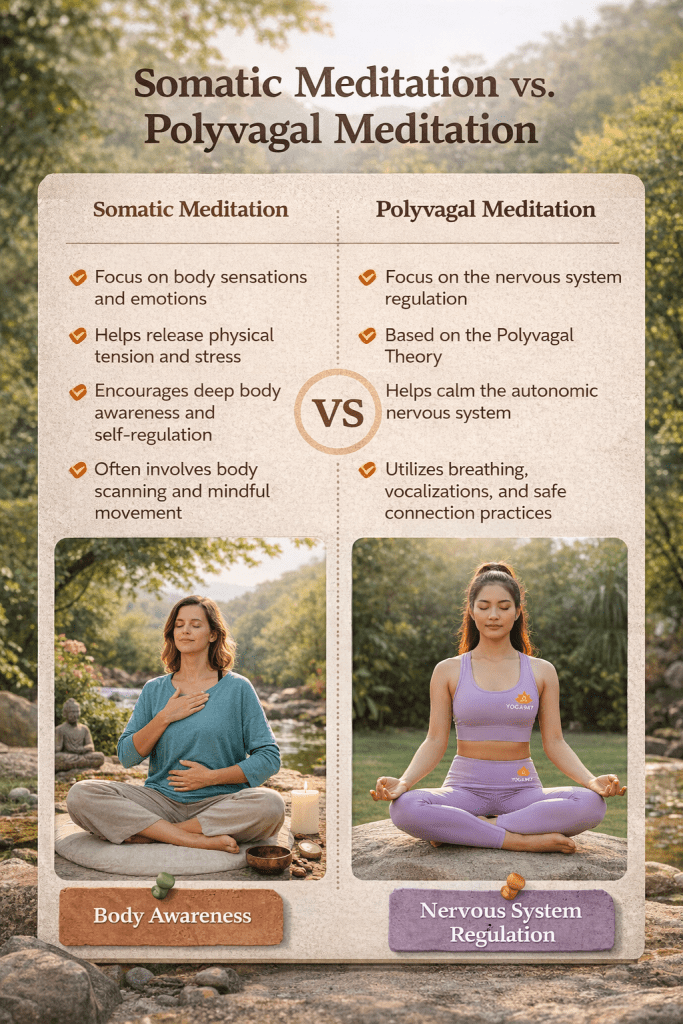
Polyvagal Somatic Meditation offers a gentler alternative.
Instead of forcing calm or clearing the mind, this practice focuses on listening to the body, noticing sensations, and allowing the nervous system to naturally settle. There is no pressure to “do it right,” no need for perfect posture, and no requirement for guided audio.
This is a meditation of safety, softness, and self-trust — ideal for beginners and experienced practitioners alike.
What Is Polyvagal Somatic Meditation?
Polyvagal Somatic Meditation is inspired by modern understandings of the nervous system and the body’s innate ability to regulate itself when it feels safe.
Rather than working only with thoughts or breath, this practice gently brings awareness to:
Physical sensations
Subtle feelings of comfort or neutrality
The body’s natural rhythms
Somatic meditation teaches us that calm is not something we create — it is something we allow when the body no longer feels threatened.
This approach is especially helpful for those who:
Feel restless or anxious during meditation
Experience burnout or chronic stress
Prefer silence or minimal instruction
Want a body-based, grounding practice
Why Polyvagal Meditation Is Growing in Popularity (2025–2026)
As awareness grows around stress, trauma, and nervous system health, many people are seeking low-stimulation, body-led wellness practices.
Polyvagal somatic meditation is becoming popular because it:
Respects individual sensitivity
Avoids overwhelming guidance
Encourages self-paced healing
Works without complex techniques or tools
Rather than pushing through discomfort, this practice invites gentle presence, helping the nervous system recognise moments of safety and rest.
How to Practice Polyvagal Somatic Meditation
(No Guided Audio Required)
Read the instructions once, then allow yourself to practice in silence.
Step-by-Step Practice (7–10 Minutes)
1. Find a comfortable position Sit or lie down in a way that feels supportive. You may close your eyes or keep them softly open.
2. Let the body arrive Notice where your body makes contact with the chair, floor, or bed. Feel the support beneath you.
3. Allow the breath to be natural There is no need to change or control your breathing. Simply notice it as it is.
4. Bring attention to sensation Gently scan the body and notice any areas that feel:
Neutral
Warm
Heavy
Supported
There is no need to focus on discomfort.
5. Stay with what feels safe When you find a sensation that feels steady or comforting, allow your awareness to rest there.
6. Remain for several minutes If the mind wanders, gently return to the sensation or point of contact.
Optional timing guide
Minutes 0–3: Grounding & settling
Minutes 3–6: Sensory awareness
Minutes 6–10: Rest & integration
7. Closing the practice When ready, gently open your eyes and notice how your body feels.
4
Some people find it helpful to practice this meditation with soft ambient sounds rather than spoken guidance.
Gentle soundscapes can support nervous system regulation without distraction.
Recommended options
Rain or ocean sounds
Brown noise or low steady tones
Nature ambience (forest, wind, distant water)
These sounds can help create a sense of continuity and safety while keeping the practice silent and self-guided.
You may explore calming tools and sound resources through YogaTrustedSite, where supportive meditation accessories and sound options are curated for gentle practices.
Benefits of Polyvagal Somatic Meditation
With regular practice, many people experience:
Reduced stress and anxiety
Greater emotional regulation
Improved sleep readiness
Increased body awareness
A deeper sense of safety and grounding
Because this practice works with the nervous system rather than against it, benefits often feel subtle but deeply stabilising.
Who This Practice Is Especially Helpful For
Polyvagal Somatic Meditation may be ideal if you:
Feel overwhelmed by guided meditations
Are you recovering from burnout or chronic stress
Prefer silence or minimal instruction
Are new to meditation
Want a body-based approach to calm
There is no expectation to feel peaceful immediately. Even noticing moments of neutrality is progress.
Reflection Prompts (Optional Journaling)
After your meditation, you may wish to reflect on one or two of the following:
Where in my body did I feel the most support today?
What sensations helped me feel grounded?
What did my nervous system need during this practice?
How do I feel compared to before the meditation?
These reflections help integrate the practice gently into daily life.
A Gentle Invitation
Polyvagal Somatic Meditation reminds us that healing does not need to be intense or forced. Sometimes, the most powerful change begins with simply feeling safe enough to rest.
If you would like deeper support:
Explore the Polyvagal Somatic Reflection Mini Journal (coming soon)
Discover calming tools and ambient supports via YogaTrustedSite
Join the Yoga947 newsletter for weekly meditation guidance and gentle practices
Peace begins within the body — one safe moment at a time. — Yoga947